

Paradise Garden: The Iconography of Rita Miramontes
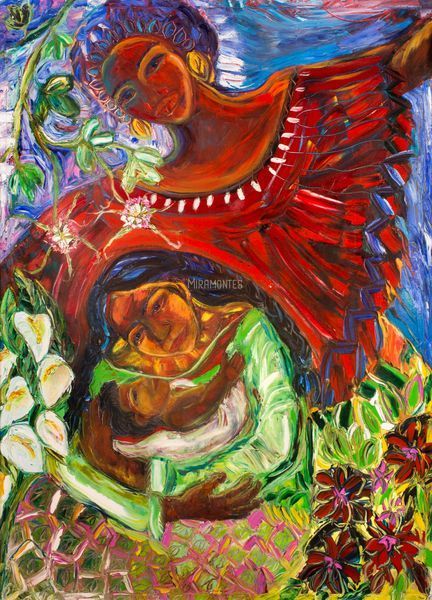
The Child's Hope by Rita Miramontes. See the print
A Universal Myth
The major iconography in Rita Miramontes' work is related to contemporary and ancient paradisal mythology. Miramontes extensively researched paradisal mythology from many cultures and time periods, and she saw in those cultural stories a correlation that seemed to exist and extend across all barriers of time and distance.
She found the concept of Paradise, the Paradisal Garden, to be a universal myth. Her paintings express this by combining Paradise iconography and myth from many cultures to make one statement.
The Permanence of Paradise
A monumentality exists to the permanence of the concept of Paradise, and it is this permanence that Miramontes wishes to express through her work. The celebration of life depicted in all cultures is brought together into a diverse yet unified mythology.
You can see this symbolism at work in The Child's Hope, where the vine stands for the continuance of life through the generations, and the passion flowers and calla lilies speak of a mother's passion and her desire for peace for her child.
A Lifetime of Study
Paradise has been the center of Rita's work for decades. She wrote her thesis on Paradise mythology, with an emphasis on ancient and Indigenous cultures and multiculturalism. Her major work, the Celebration of Life mural series, stretches 63 feet across 22 panels and explores Paradise mythology in ancient cultures. See paintings from the Celebration of Life series.
More in This Series
This article is part of a series on the art of Rita Miramontes.
- The Visual Language of Color
- Face to Face with the Dance
- Words in the Paint
- How Rita Paints: Impasto, Color and Light
Explore the paintings in the full collection, or read more about Rita.